
What Makes a DeFi Protocol Ready for Long-Term Liquidity?
Reliable liquidity depends on more than audited contracts. Governance, infrastructure dependencies, collateral controls, and operational readiness shape whether capital can enter, remain in, and leave a protocol under changing market conditions.
Smart contract audits are an essential part of protocol assessment. They help identify weaknesses in a particular codebase, under a defined scope and set of assumptions. They do not establish that every system surrounding those contracts will behave safely throughout the life of a liquidity position.
For a liquidity provider, the exposure extends beyond a deposit transaction. Capital may depend on administrators, governance decisions, price feeds, bridge infrastructure, transaction-signing processes, and the availability of an exit route. Each dependency can change the economics or accessibility of a position even when the core contracts operate as written.
The practical assessment starts with a straightforward question: what could prevent this capital from being managed or withdrawn on the terms expected? Answering it requires a view of the whole operating environment, including the controls that apply when normal conditions break down.
This is particularly relevant to long-term participation. A temporary incentive can compensate for some costs, but it does not remove uncertainty about upgrade authority, collateral quality, or incident handling. Sustainable liquidity relationships depend on risks that can be identified, monitored, and managed.
Protocol Risk Extends Beyond Contract Code
An assessment should distinguish between the code currently deployed and the authority to change it. An audited implementation may sit behind an upgradeable proxy. A privileged account may be able to pause withdrawals, change a price feed, or introduce a new collateral asset. Those powers can be necessary, but their scope and safeguards should be visible.
The same principle applies to external infrastructure. A protocol that accepts bridged assets inherits assumptions about how those assets are secured and redeemed. A lending market depends on prices arriving with suitable freshness and integrity. An interface can display a transaction that differs from the action a signer believes they are authorising.
Dependencies should therefore be documented as operational relationships rather than treated as a list of integrations. For each critical service, teams should identify who controls it, what failure looks like, how that failure is detected, and which functions remain available afterward.
Independent reviews remain valuable evidence. Their relevance depends on the deployment version, findings, remediation status, and assumptions tested. A report should be read alongside the current configuration and change history, rather than treated as a permanent assurance of safety.
Liquidity Decisions Depend on Operational Resilience
Liquidity providers manage more than the amount deposited in a pool. They must consider inventory, hedging, settlement, counterparty exposure, and the time needed to reduce risk. A position that appears liquid under normal conditions may become difficult to adjust when several participants seek the same exit.
Operational failures can affect those decisions before a direct loss occurs. Uncertainty about an upgrade, an unreliable price feed, or a delayed withdrawal can cause providers to reduce size or demand a larger margin for risk. The resulting change in available liquidity may affect execution quality for other users.
Controls should be assessed against realistic stress scenarios. What happens if a primary operator is unavailable? Can a transaction be independently checked before signing? Does a pause prevent new exposure while preserving a controlled path for existing users? These questions are more useful than a general claim that a system is resilient.
Capital allocation also depends on ongoing visibility. Providers need to know which changes require renewed review and how much notice they will receive. Clear release procedures, documented permissions, and timely incident communication make that monitoring more practical.
Strong controls cannot eliminate market or technical risk. They can make the limits of a position easier to understand and reduce the chance that an isolated failure spreads through connected systems.
Six Areas to Assess Before Committing Liquidity
A practical review combines contract-level work with evidence about how the protocol is governed and operated. The six areas below provide a framework for organising that review. They are questions to investigate, not a certification or a guarantee of liquidity.
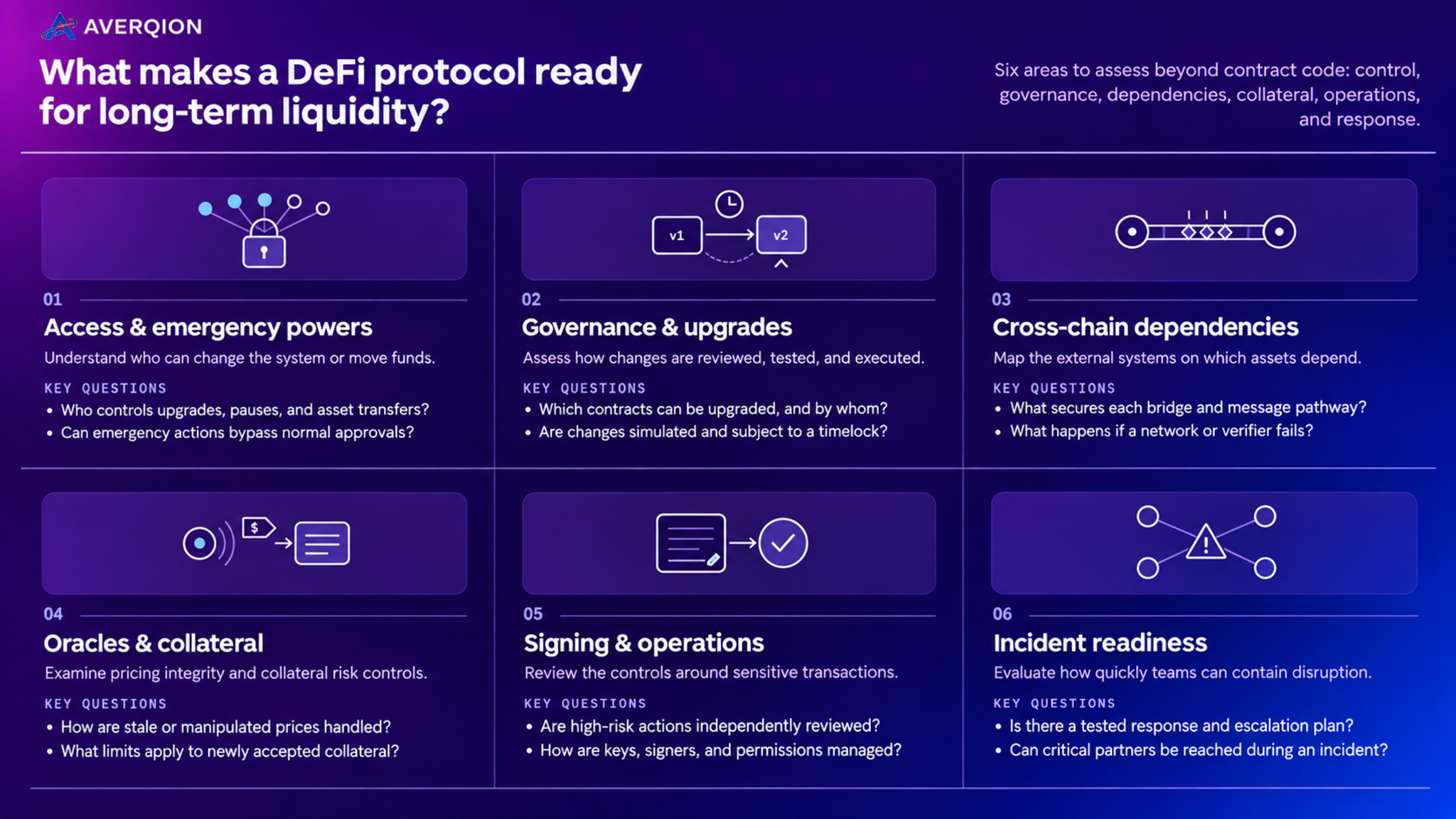
Access & Emergency Powers
Who can upgrade contracts, pause markets, or move funds? Map each privileged role to its actual on-chain permissions. Review signer independence, approval thresholds, key replacement, and the conditions under which emergency powers can bypass ordinary procedures. A multisignature wallet is a control mechanism; its effectiveness still depends on who holds the keys and how approvals are obtained.
Governance & Upgrades
Which contracts can be changed, and who can approve those changes? Check whether proposed upgrades are reviewed, simulated, and subject to an appropriate delay. Teams should retain a deployment record and a recovery plan. Liquidity providers also need enough information to understand whether a change alters withdrawal behaviour, collateral treatment, or the assumptions behind an existing position.
Cross-Chain Dependencies
What secures each bridge and message pathway? Identify verification thresholds, administrator permissions, and the relationship between the asset held and its underlying backing. Consider what happens if a network, verifier, or message service fails. A fallback route should be assessed on its own risks and capacity rather than assumed to remain available during a wider disruption.
Oracles & Collateral
How are stale, unavailable, or manipulated prices handled? Review the source and frequency of price updates, deviation controls, and the actions permitted when prices are uncertain. Collateral limits should reflect liquidity and concentration as well as nominal value. Newly accepted assets may require conservative caps and explicit monitoring before they can support larger exposures.
Signing & Operations
Are sensitive transactions independently reviewed before execution? A robust process connects the business intention to the exact addresses, permissions, and values being signed. Key storage, signer access, transaction simulation, and reconciliation all contribute to this control. Teams should also understand how they would continue essential operations if a signing device or service became unavailable.
Incident Readiness
Is there a tested response and escalation plan? Define who can make urgent decisions, how users receive updates, and how critical partners can be reached. Exercises should include detection, containment, recovery, and a review of what happened. A documented process is most useful when the people responsible have practised it and know the limits of their authority.
Building Confidence Through Observable Controls
Protocols can make assessment easier by maintaining a clear, current record of their operating model. Permission maps, deployment addresses, review reports, upgrade procedures, dependency documentation, and incident contacts provide a useful starting point. The objective is to make important assumptions visible and changes traceable.
For liquidity providers, the review should lead to practical decisions: appropriate exposure limits, monitoring requirements, escalation triggers, and conditions for reducing or withdrawing capital. These decisions should be revisited when the protocol changes, rather than remaining fixed after initial onboarding.
Long-term liquidity is supported by confidence in how a system behaves across market conditions. Contract security is part of that confidence. So are disciplined governance, dependable operations, and evidence that risks can be contained when something goes wrong. The strongest case for sustained participation is a set of controls that can be examined and maintained over time.