
How to Evaluate a Digital Asset Market Maker
Choosing a market maker requires more than comparing quoted spreads. This guide examines liquidity quality, execution transparency, and operational resilience—the evidence that helps token projects, exchanges, and institutions assess a potential partner.
Choosing a market maker is a decision about how a market will operate, how assets will be used, and how performance will be measured. A narrow quoted spread is useful, but it says little about the size available behind that quote or the conditions under which it can be maintained.
A sound evaluation starts with the mandate. A token project seeking continuous two-sided quotes, an exchange assessing order-book quality, and an institution executing a large transaction have different requirements. The proposed service, supported venues, inventory arrangements, and reporting obligations should reflect those differences.
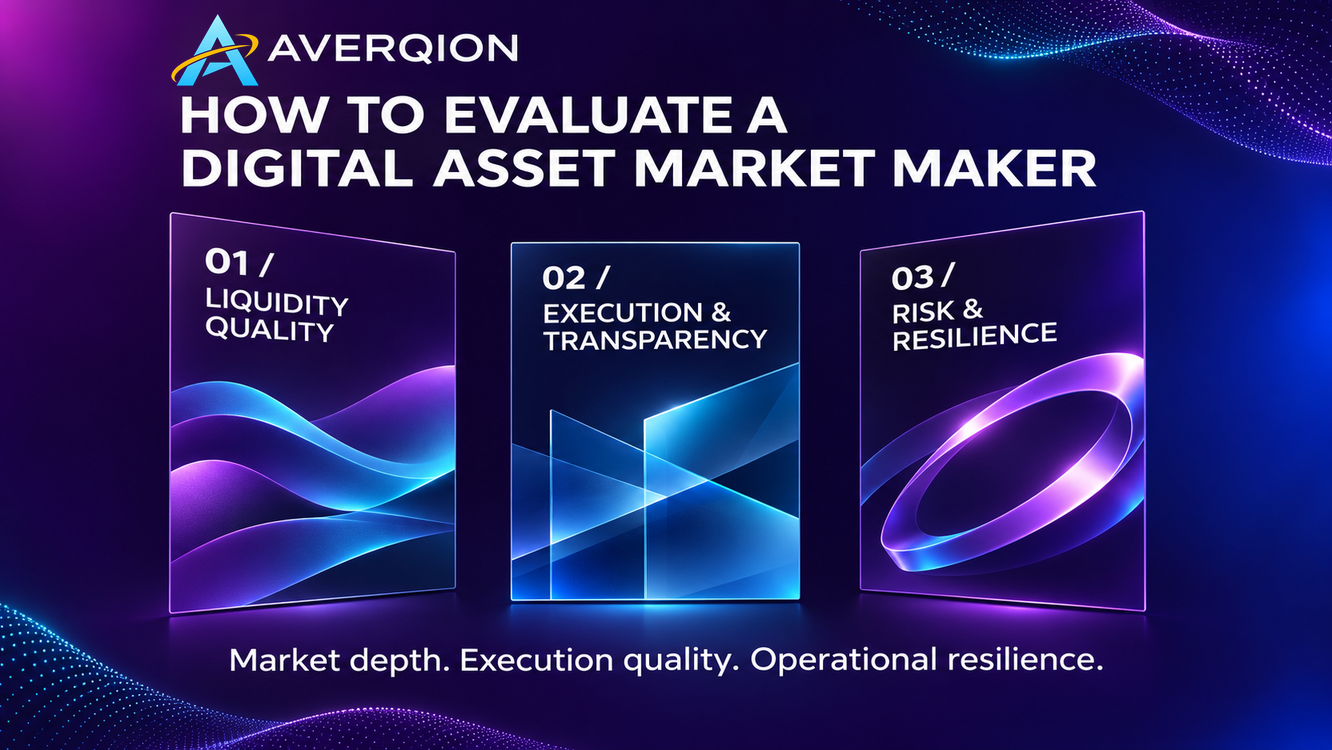
The three areas below provide a practical basis for that assessment: liquidity quality, execution and transparency, and risk and resilience.
1. Liquidity Quality: Look Beyond Headline Volume
Measure what participants can execute, not just what a market reports.
Reported turnover records activity over a period. It does not establish the quantity that can be bought or sold now at a given price. High volume can coexist with shallow order books, particularly when activity is concentrated in a small number of venues or short trading windows.
Assess depth within consistent price bands on both sides of the market. A balanced comparison should include spreads, available size, and the estimated cost of executing representative orders. A provider quoting tightly for a very small quantity may offer less useful liquidity than one supporting meaningful size at a slightly wider spread.
Continuity matters as much as a favourable snapshot. Review how often quotes are available, how they behave outside peak trading hours, and how quickly depth returns after trades consume it. Normal conditions and periods of market stress should be examined separately, with outages and missing data identified rather than silently excluded.
Ask for evidence that matches the proposed asset and venue coverage. Experience in a liquid large-cap market does not automatically establish the ability to manage a newly listed token or an on-chain pool with different inventory and fee dynamics.
- What quantity is available within agreed price bands, on both sides of the market?
- How do spreads, depth, and quote availability vary across time and market conditions?
- Which venues and timestamps are included in the data, and how are gaps handled?
- How quickly does liquidity replenish after representative trades?
Define each metric before setting a target. Quote availability, for example, is meaningful only when the required size, spread, observation interval, and permitted exceptions are also specified.
2. Execution & Transparency: Understand the Evidence
Clear commercial terms and reproducible reporting make performance assessable.
Distinguish continuous market-making services from agency execution and principal trading. Each involves different responsibilities and incentives. A provider posting its own quotes is not performing the same task as an agent routing a client order, even if both activities appear in a proposal under the heading of liquidity provision.
For execution services, compare realised results with a benchmark chosen in advance. Include fees and report order size, timing, partial fills, and uncompleted quantities. A comparison based only on completed trades may overlook the cost of delays or missed execution. Quote validity and settlement terms also affect whether apparently similar prices are comparable.
For market-making mandates, reporting should connect the agreed obligations to observable venue data. Summaries should be supported by sufficiently detailed records to investigate exceptions. Ask how the provider separates its own activity from broader market changes and whether the client can independently reproduce the core calculations.
Understand the economics of the relationship. Retainers, token loans, options, revenue sharing, and trading-related incentives create different exposures. Specify who owns inventory, how it may be used, how gains and losses are allocated, and what happens when the arrangement ends. These terms should be considered alongside the headline fee.
- What precisely is promised, and how will compliance with the mandate be measured?
- Can reported spreads, depth, and execution results be checked independently?
- Which fees, asset-use rights, and potential conflicts of interest are disclosed?
- What records will be supplied, at what frequency, and to whom?
Targets should describe legitimate liquidity provision. They should not reward artificial volume, self-trading, or attempts to maintain a predetermined token price. Commercial incentives need to support the quality of the market participants actually experience.
3. Risk & Resilience: Assess the Operating Model
A quotation is supported by people, systems, capital, and controls.
Review the resources required to sustain the proposed coverage. Inventory, funding access, venue limits, and hedging arrangements influence what a provider can maintain when markets move quickly. Several trading connections may still depend on a single exchange, custodian, or funding channel; map those concentrations explicitly.
Asset arrangements require particular clarity. Establish where funds are held, who can transfer them, what permissions are granted, and how balances are reconciled. Access to a trading account should not be confused with unrestricted authority over assets. Sensitive changes and transfers should have defined approval and review procedures.
Operational assessment should cover both prevention and response. Ask how the team detects stale prices, connectivity failures, unusual inventory changes, and settlement delays. Understand when quoting may be reduced or suspended, who is notified, and how normal operations are restored.
Continuous markets need clearly assigned coverage and escalation responsibilities. A response plan is more useful when the people involved have tested it and can explain what happened during a previous exercise or incident. Request evidence appropriate to the relationship without assuming that a polished policy document establishes effective execution.
- Who can move assets, change trading permissions, or adjust risk limits?
- What happens if a key venue, network, or settlement route becomes unavailable?
- How are incidents recorded, escalated, communicated, and reviewed?
- What are the inventory return, reconciliation, and handover arrangements at termination?
Resilience does not mean uninterrupted quoting at any cost. It means that limits, exceptions, and recovery procedures are understood before they are needed, and that actions taken during disruption are accountable.
Making the Selection
Translate the assessment into a consistent selection process. Begin with the assets, venues, service hours, and commercial scope. Give candidates the same definitions and representative requirements so that differences in their proposals can be interpreted fairly.
Review supporting evidence, clarify assumptions, and identify gaps before agreeing to a mandate. Where a bounded evaluation period is appropriate, specify its duration, inventory exposure, reporting requirements, and success criteria in advance. The exercise should test the proposed service rather than produce an attractive but unrepresentative demonstration.
Document the agreed measures, permitted exceptions, communication schedule, and escalation path. Establish a review process that considers market conditions as well as provider performance. Targets may need to change as an asset or venue develops, but changes should be explicit and traceable.
The strongest basis for a partnership is a shared understanding of what good performance looks like and the evidence needed to assess it. Executable liquidity, transparent terms, and disciplined operations provide a more durable basis for evaluation than a headline volume figure or a promise about price.
Discuss Your Liquidity Requirements
To discuss your target markets, execution needs, or liquidity assessment priorities, contact MOCERION.