
From Quote to Fill: Inside an Institutional Crypto Trade
A quoted spread tells you where a trade might begin. The final fill tells you what it cost to complete. Between the two, order size, timing, and available liquidity determine how an institutional crypto trade gets done.

Where the trade begins
A digital asset order rarely meets a single, uniform market. Liquidity sits across centralized exchanges, decentralized venues, trading desks, and other sources. Each has its own prices, available size, access requirements, and settlement arrangements. A price on one screen is only part of the picture.
For an institutional desk, the practical question is how to complete a particular order within its constraints. A small trade in a deep market may be straightforward. A larger position, an urgent rebalance, or an asset with limited depth calls for a different approach. The trade must be considered as a whole: what can be executed, how quickly, and at what total cost.
That starts with clear instructions. The asset, direction, size, timing, and price limits should be established before choosing an execution route. Funding and settlement requirements also belong in that conversation. An attractive quote is less useful if the intended size cannot be filled or the resulting position cannot be settled as required.
For asset managers, funds, corporate treasuries, and other professional participants, a consistent process helps connect the investment decision to its actual market outcome. The aim is to preserve flexibility without losing sight of those original instructions.
Choosing how to execute
Different orders need different tools. Where immediacy and price certainty matter, a request for quote (RFQ) can establish a firm price for a specified amount, subject to its terms and validity. A limit order sets a price boundary, though it may not fill. A market order prioritizes execution against available liquidity, with the final price depending on depth and market movement.
A larger order may be worked over time. A time-weighted average price (TWAP) approach divides the instruction into smaller intervals, rather than submitting the full amount at once. That changes the balance between speed, exposure to market movement, and the footprint left by the order. It does not remove execution risk.
The appropriate route depends on size, urgency, available depth, and the liquidity profile of the asset. Access may be through a trading interface, a desk relationship, or an API where supported. The interface should carry the same instructions through pricing, execution, and confirmation, so that operational convenience does not obscure what the order is meant to achieve.
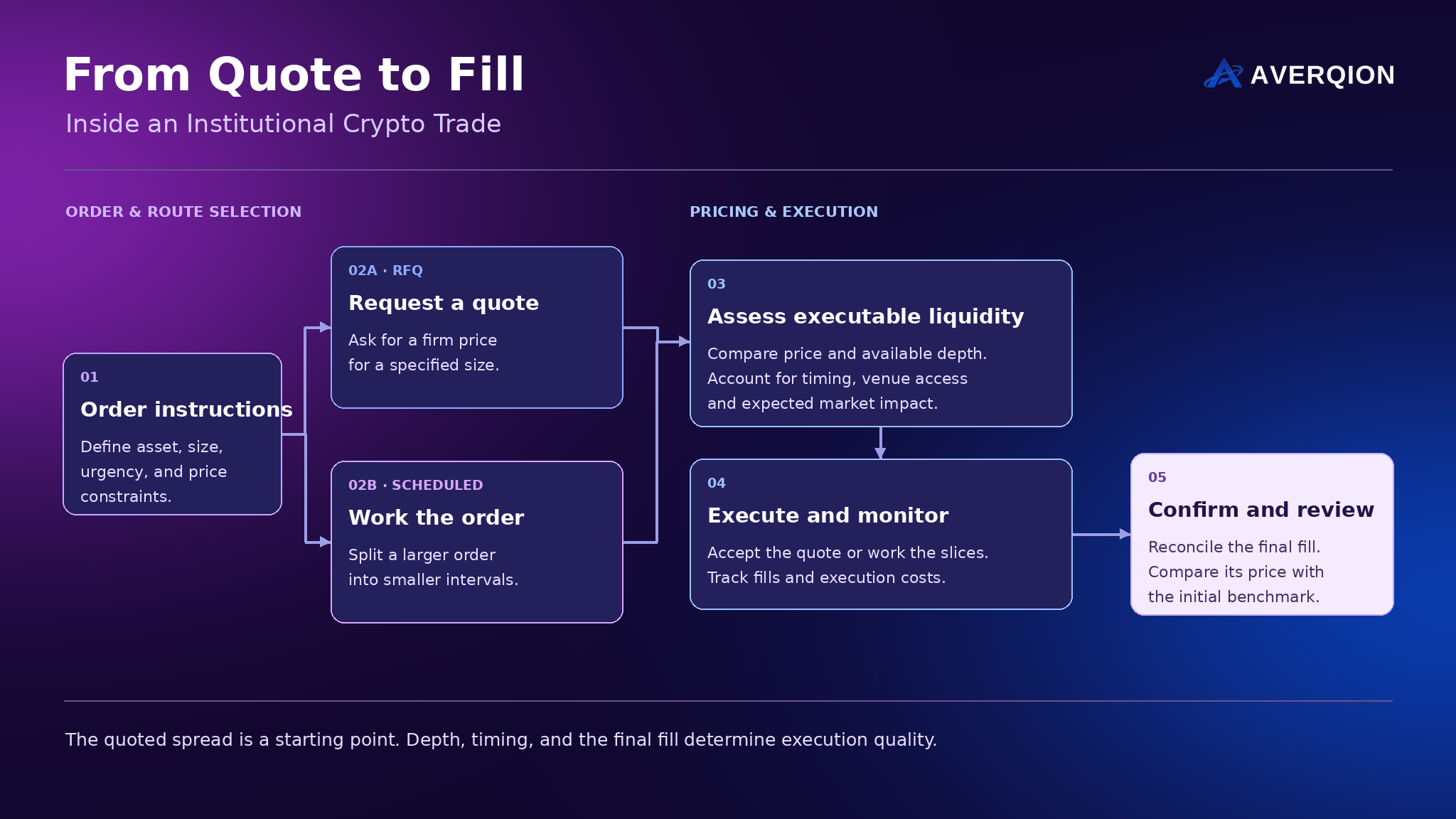
The workflow below brings those decisions together. Whether the route is an immediate quote or a scheduled order, executable liquidity must be assessed before the trade is completed and reviewed.
Read the workflow
- Define the asset, size, urgency, and price constraints.
- Request a firm quote for a specified size, or split a larger order into scheduled intervals.
- Compare price and available depth, accounting for timing, venue access, and expected market impact.
- Accept the quote or execute the slices, tracking fills and execution costs.
- Reconcile the final fill and compare its price with the initial benchmark.
Liquidity, pricing, and less-traded assets
The visible spread is a useful starting point, but it does not describe the cost of completing every order. Depth can vary across venues and change while a trade is in progress. The relevant price is the one available for the required amount, including the effect of working through that liquidity.
Assessing several sources can provide a fuller picture of executable size. Quotes still need to be compared on equivalent terms: the same asset, direction, size, timing, and settlement conditions. A narrow spread for a small amount should not be treated as a commitment to fill a much larger order at the same level.
Trading costs also extend beyond the headline quote. Depending on the arrangement, fees, transfers, funding, and settlement can affect the result. These costs should be understood before execution and reconciled afterward. A useful review distinguishes the original benchmark from market movement, execution decisions, and explicit charges.
These questions become more important outside the most actively traded assets. Less-traded tokens may have uneven depth, limited venue coverage, or more demanding access and transfer arrangements. A route that works well for one asset may be unsuitable for another. Execution planning should reflect the market that actually exists, rather than assume that liquidity is interchangeable.
Counterparty relationships and settlement
Access to multiple liquidity sources brings operational questions as well as pricing opportunities. Each relationship may have different documentation, credit terms, funding requirements, and settlement processes. Managing those differences is part of completing the trade.
Where a principal trading arrangement uses one counterparty, the institution may maintain a single relationship while that counterparty manages its own sourcing and risk. Other arrangements leave more venue relationships with the institution. The responsibilities should be explicit: who executes, who owes each asset, and which terms apply if an order or settlement is delayed.
Settlement should be planned before the order is placed. Both sides need agreed asset and network details, delivery instructions, timing, and reconciliation procedures. Any deferred settlement or credit arrangement depends on the terms actually agreed; it should never be assumed from the availability of a quote.
Access controls matter throughout the workflow. Account permissions, approval limits, authentication, and records of instructions help separate authority to trade from authority to move assets. Onboarding, documentation, and applicable compliance checks should be completed through the relevant provider's established process.
The objective is continuity. An order should move from instruction to confirmation without losing the details that the trading, operations, and treasury teams need to complete their respective work.
What to review after the fill
Confirmation is a checkpoint, not the end of the analysis. The completed size, average execution price, timestamps, explicit costs, and settlement records should be reconciled against the instruction. Partial fills, changes, and exceptions need to be visible.
The next question is how the result compares with the original benchmark. Did the order fill within the intended time and price constraints? Did liquidity change during execution? Were costs driven by market movement, the route selected, or the amount available at each price? Looking at those questions separately makes the review more useful than judging a trade by its initial spread alone.
Institutional execution brings together market access, pricing, order handling, and operational follow-through. A clear workflow connects those elements, while leaving room to choose the route that fits the trade.
The quote is the starting point. The completed trade is the measure.
To discuss these considerations with MOCERION, contact our team.